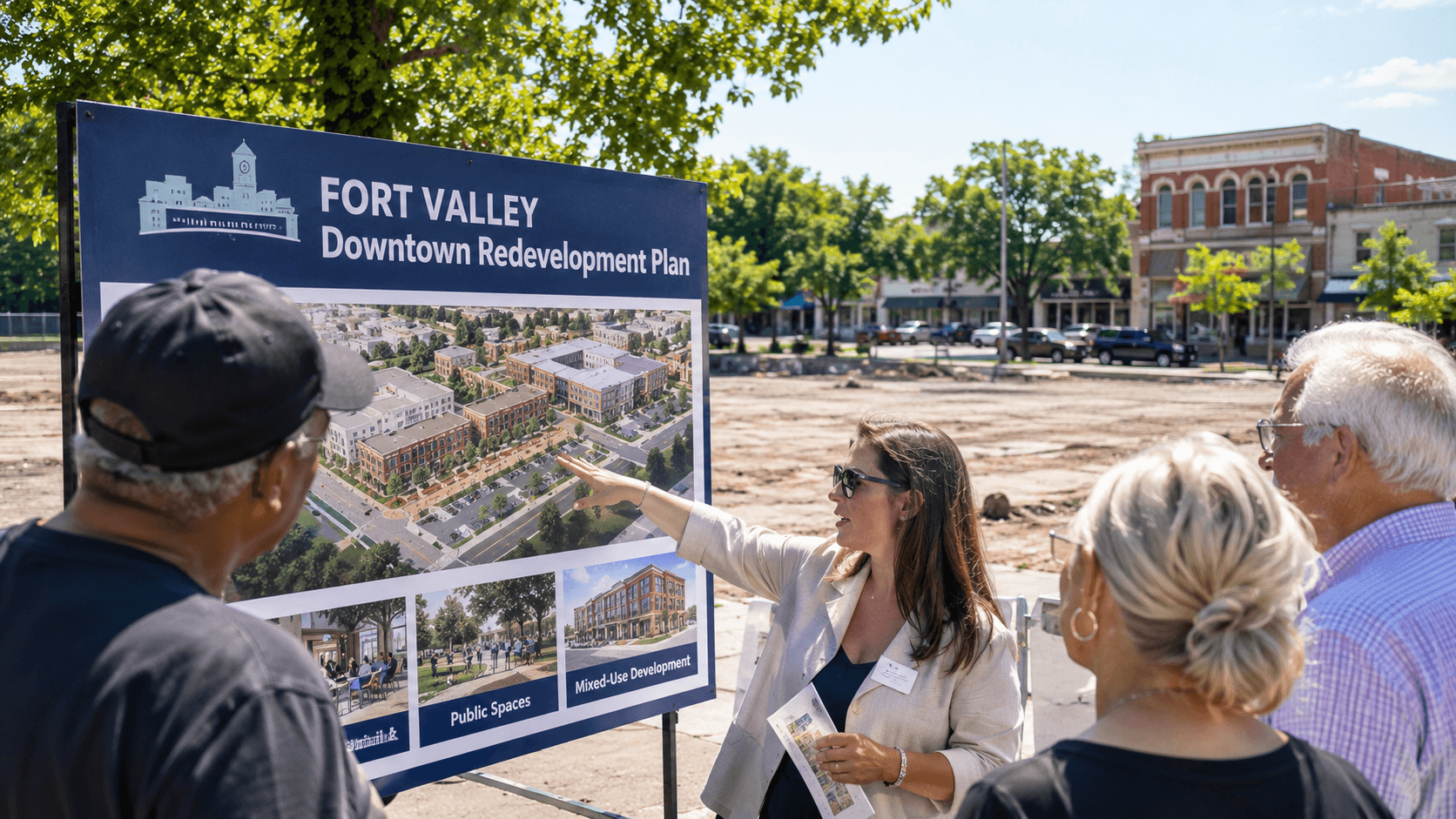
A former industrial property in downtown Fort Valley could become part of the city's next chapter—but its future will depend on decisions still ahead.
The former Woolfolk Chemical Works site has completed environmental remediation, and city redevelopment plans envision a mix of community services, housing and retail potential.
For residents, the story is about more than what might be built on one property. It is about how a long-vacant area could reconnect with the rest of downtown.
The plan describes a direction for redevelopment, not a guaranteed construction schedule.
At a Glance
Why the downtown location matters
Downtown redevelopment can affect far more than the boundaries of a single lot. New activity can influence how residents move through a neighborhood, where they access services and whether nearby businesses see opportunities to invest.
The former Woolfolk property sits near community institutions and the renovated Troutman House, which supports local organizations.
That location makes the site's future particularly important: a successful project could strengthen connections among downtown destinations instead of functioning as an isolated development.
What ultimately matters is whether the finished project meets local needs and fits the surrounding neighborhood.
What could change for residents
Community services could bring more activity to the area. Housing could add residents close to downtown destinations. Retail space could create room for businesses to serve nearby households.
But each possibility comes with practical questions. How would traffic and parking work? What kinds of housing or services would be included? Who would fund construction and maintain the property?
Those questions are not reasons to dismiss redevelopment. They are reasons for residents to follow the details as the city and potential partners move forward.
What remains undecided
The city is pursuing a combination of private, state and federal support. Financing and partnerships will help determine which parts of the vision can advance and on what timetable.
A planning framework should not be confused with a funded project or a confirmed opening date.
What to watch next
Residents can look for public updates about funding commitments, development agreements, design decisions and construction phases. Public discussions will be especially useful as proposals become more specific.
Why cleanup and redevelopment are separate milestones
Completing environmental remediation is an important part of a former industrial property's history. It does not, by itself, determine what will be built next, who will pay for it or when residents might see construction.
Redevelopment usually involves additional choices about land use, financing, design and long-term operations. That is why a completed cleanup and an active planning vision can coexist with an uncertain construction timetable.
For neighbors, keeping those milestones separate makes public updates easier to evaluate. An announcement about a grant application is different from a funded construction contract. A conceptual design is different from an approved final plan.
What a community-focused project could look like
The proposed mix of services, housing and retail leaves room for different approaches. Residents may have different priorities: convenient access to services, housing that fits local needs, space for small businesses or streets that feel comfortable to walk.
Those priorities are not always simple to balance. More activity can bring opportunity, but it can also raise questions about parking, traffic, affordability and how new buildings fit alongside existing downtown properties.
Public input can help clarify which concerns deserve attention before a proposal becomes final. The useful questions are specific: Who would use a proposed space? How would it connect to nearby streets? What would it cost to maintain over time?
Why nearby businesses have a stake
Downtown merchants may benefit if a successful project brings more people into the area. But the outcome depends on how the property is developed and whether visitors can easily reach surrounding storefronts.
Construction could also bring temporary disruptions if a project advances. Businesses will need accurate schedules and access information rather than broad assurances that redevelopment is always positive.
How residents can follow the process
Watch for funding decisions, formal proposals and public meetings where plans are presented in detail. When officials release documents, look for what is funded, what remains conceptual and which decisions still require approval.
Residents can ask how the project would serve existing neighborhoods, what happens if financing changes and whether the city has identified a realistic sequence for the work.
That kind of steady attention can help turn a promising downtown vision into a project shaped by the people who will live with its results.
The takeaway for Fort Valley: The former Woolfolk site offers a meaningful chance to strengthen downtown. Whether that potential becomes a lasting community benefit will depend on funding, careful planning and the decisions made along the way. |
2 Comments
Join the conversation
The plans sound promising, but funding still seems like the big question. Which parts of the project could move forward first?
Finishing the cleanup at the Woolfolk site is good news. What would need to happen before the city can set a construction timeline?